What are FODMAPS
January 20, 2026
FODMAP stands for Fermentable Oligosaccharides, Disaccharides, Monosaccharides And Polyols – basically a group of short-chain carbohydrates that are poorly absorbed in the small intestine.
What Makes a Food “High FODMAP”?
A food is categorized as high FODMAP based on specific threshold values for each carbohydrate type per standard serving size:
Quantitative Thresholds:
- Fructose (excess): >0.2g more fructose than glucose per serving
- Lactose: >1g per serving
- Fructans: >0.2g per serving
- Galacto-oligosaccharides (GOS): >0.2g per serving
- Polyols (sorbitol, mannitol): >0.2g per serving
Foods containing these amounts trigger symptoms because they’re poorly absorbed in the small intestine, drawing water into the gut and fermenting rapidly when they reach the colon.
The Five FODMAP Categories
1. Oligosaccharides
Fructans – chains of fructose molecules that humans lack enzymes to break down
Galacto-oligosaccharides (GOS) – chains of galactose molecules found primarily in legumes
2. Disaccharides
Lactose – milk sugar requiring the enzyme lactase for digestion
3. Monosaccharides
Excess Fructose – free fructose not balanced by glucose, poorly absorbed when in excess
4. Polyols
Sugar alcohols including sorbitol, mannitol, xylitol, maltitol, and isomalt – naturally occurring or used as sweeteners
Important Considerations
Serving Size Matters: Many moderate FODMAP foods become high FODMAP in larger servings. For example, avocado is low FODMAP at 1/8 of a fruit but high FODMAP at 1/4 fruit.
Stacking Effect: Eating multiple moderate FODMAP foods in one meal can create a cumulative high FODMAP load, triggering symptoms even when individual foods would be tolerable.
Individual Variation: FODMAP tolerance is highly individual. Some people react strongly to fructans but tolerate lactose well, while others have the opposite experience.
Processing Changes FODMAP Content: Cooking methods, ripeness, and food processing affect FODMAP levels. Unripe bananas are lower FODMAP than overripe ones. Canned lentils have lower GOS than dried lentils due to leaching into the liquid.
Not Forever: The low FODMAP diet is designed as a diagnostic tool, not a permanent eating pattern. After identifying triggers through systematic reintroduction, most people can include many moderate and some high FODMAP foods without symptoms.
The Three-Phase Approach
Phase 1 – Elimination (2-6 weeks): Strictly avoid high FODMAP foods to allow symptoms to settle and establish a baseline.
Phase 2 – Reintroduction (8-12 weeks): Systematically test individual FODMAP groups to identify personal triggers. Test one FODMAP type at a time in increasing amounts.
Phase 3 – Personalization (Ongoing): Create a sustainable long-term diet that includes as many foods as individually tolerated, avoiding only confirmed triggers.
Working With Healthcare Professionals
The low FODMAP diet is complex and should ideally be undertaken with guidance from a registered dietitian experienced in digestive health. Professional support helps ensure nutritional adequacy, proper reintroduction technique, and identification of other potential dietary triggers beyond FODMAPs.
Many high FODMAP foods like garlic, onions, wheat, and legumes contain valuable prebiotics that feed beneficial gut bacteria. Long-term unnecessary restriction can negatively impact gut microbiome diversity, which is why personalization based on individual tolerance is crucial.
Complete FODMAP Food Reference Chart
| Food | FODMAP Level & Type | Notes |
|---|---|---|
| VEGETABLES | ||
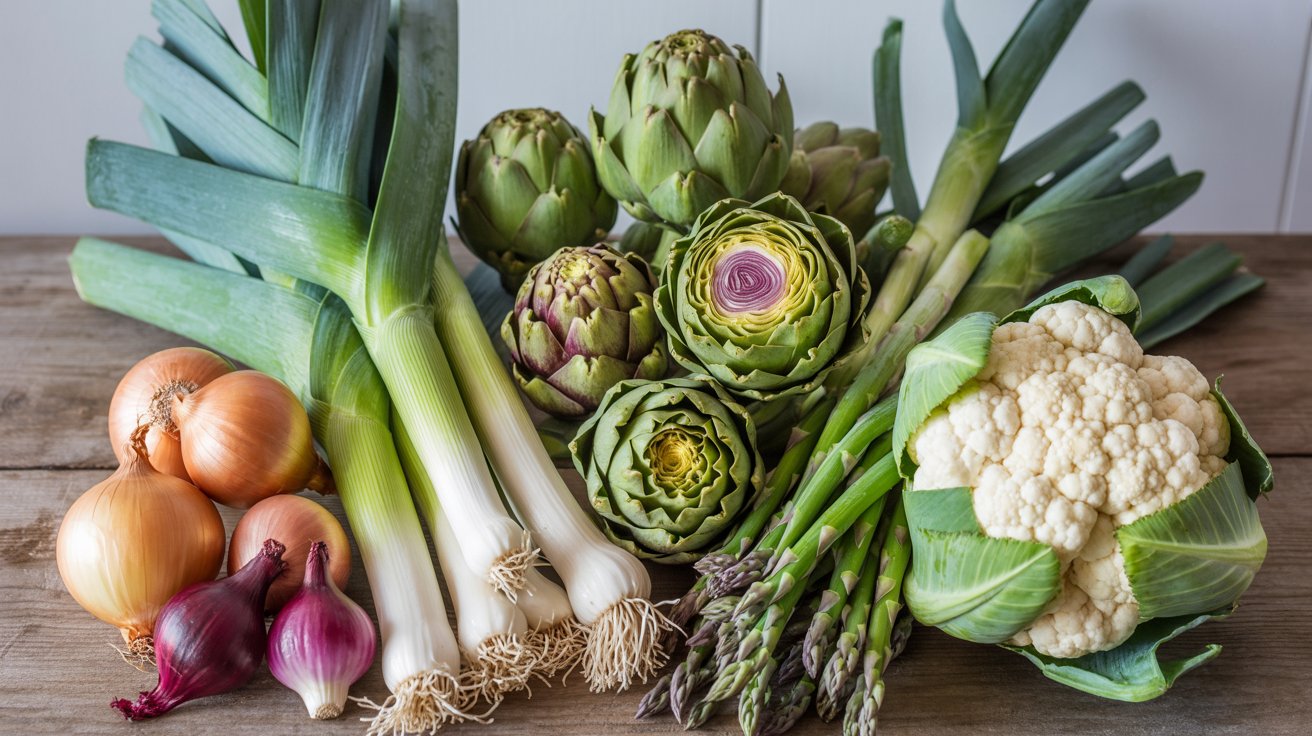
| Garlic | 🔴 Very High (Fructans) | Extremely high – even small amounts trigger symptoms |
| Onions (all types) | 🔴 Very High (Fructans) | Avoid completely during elimination |
| Shallots | 🔴 Very High (Fructans) | Similar to onions |
| Leeks (bulb) | 🔴 Very High (Fructans) | Green tops are lower FODMAP |
| Artichokes | 🔴 Very High (Fructans) | Very high in standard servings |
| Asparagus | 🔴 Very High (Fructans) | Limit to 1 spear maximum |
| Cauliflower | 🟠 High (Fructans, Mannitol) | Limit to 1/8 cup florets |
| Mushrooms | 🟠 High (Mannitol, Fructans) | Varies by type, limit to small amounts |
| Snow peas | 🟠 High (Fructans, GOS) | Limit to 5 pods |
| Sugar snap peas | 🟠 High (Fructans, GOS) | Limit to 5 pods |
| Brussels sprouts | 🟠 High (Fructans, GOS) | Limit to 2 sprouts |
| Cabbage (savoy) | 🟠 High (Fructans, GOS) | Common cabbage is lower |
| Beetroot | 🟠 High (Fructans) | Limit to 2 slices |
| Celery | 🟠 High (Mannitol) | Limit to 5cm stalk piece |
| Sweet corn | 🟠 High (Sorbitol, Fructans) | Limit to 1/2 cob |
| Broccoli | 🟡 Moderate (Fructans) | Low in 1/2 cup, high in larger serves |
| Butternut pumpkin | 🟡 Moderate (Fructans, GOS) | Low in 1/4 cup, moderate in larger |
| Fennel bulb | 🟡 Moderate (Fructans) | Limit to 1/2 cup |
| Okra | 🟡 Moderate (Fructans, GOS) | Moderate in standard servings |
| Green peas | 🟡 Moderate (GOS) | Low in small serves, moderate in larger |
| Baby corn (canned) | 🟡 Moderate (Sorbitol) | Lower than fresh corn |
| Carrots | 🟢 Low | Well tolerated in all amounts |
| Cucumber | 🟢 Low | Well tolerated in all amounts |
| Lettuce (all types) | 🟢 Low | Well tolerated in all amounts |
| Tomatoes | 🟢 Low | Well tolerated in all amounts |
| Zucchini | 🟢 Low | Well tolerated in all amounts |
| Green beans | 🟢 Low | Well tolerated in all amounts |
| Bok choy | 🟢 Low | Well tolerated in all amounts |
| Bell peppers | 🟢 Low | Well tolerated in all amounts |
| Eggplant | 🟢 Low | Well tolerated in all amounts |
| Potatoes | 🟢 Low | Well tolerated in all amounts |
| Spinach | 🟢 Low | Well tolerated in all amounts |
| Kale | 🟢 Low | Well tolerated in all amounts |
| Radishes | 🟢 Low | Well tolerated in all amounts |
| Turnips | 🟢 Low | Well tolerated in all amounts |
| Parsnips | 🟢 Low | Well tolerated in all amounts |
| Chives (green tips) | 🟢 Low | Green parts only, not bulbs |
| FRUITS | ||
| Apples | 🔴 Very High (Fructose, Sorbitol) | Avoid completely during elimination |
| Pears | 🔴 Very High (Fructose, Sorbitol) | Avoid completely during elimination |
| Watermelon | 🔴 Very High (Fructose, Fructans) | Even small amounts problematic |
| Cherries | 🔴 Very High (Fructose, Sorbitol) | Limit to 3 cherries |
| Peaches | 🔴 Very High (Fructose, Sorbitol) | Avoid during elimination |
| Nectarines | 🔴 Very High (Fructose, Sorbitol) | Avoid during elimination |
| Plums | 🔴 Very High (Fructose, Sorbitol) | Avoid during elimination |
| Dried fruits (all) | 🔴 Very High (Concentrated Fructose) | FODMAPs concentrated during drying |
| Mango | 🟠 High (Fructose) | Limit to 1/2 cup diced |
| Persimmon | 🟠 High (Fructose, Fructans) | Avoid during elimination |
| Blackberries | 🟠 High (Polyols) | Limit to 10 berries |
| Avocado (>1/8 fruit) | 🟠 High (Sorbitol, Fructans) | Low at 1/8 fruit, high at 1/4 or more |
| Pomegranate | 🟠 High (Fructose, Fructans) | Limit to 1/4 cup seeds |
| Grapefruit | 🟠 High (Fructose) | Limit to 1/2 fruit |
| Figs | 🟠 High (Fructose) | Both fresh and dried |
| Banana (ripe/overripe) | 🟡 Moderate (Fructans) | Low when firm, moderate to high when spotted |
| Longans | 🟡 Moderate (Sorbitol) | Limit to 10 fruits |
| Lychees | 🟡 Moderate (Fructose) | Limit to 5 fruits |
| Rambutan | 🟡 Moderate (Fructose) | Limit to 3 fruits |
| Coconut (fresh/dried) | 🟡 Moderate (Sorbitol, Fructans) | Low in small amounts, moderate in larger |
| Strawberries | 🟢 Low | Well tolerated in normal servings |
| Blueberries | 🟢 Low | Well tolerated in normal servings |
| Oranges | 🟢 Low | Well tolerated – 1 medium fruit |
| Grapes | 🟢 Low | Well tolerated in normal servings |
| Kiwi | 🟢 Low | Well tolerated – 2 fruits |
| Cantaloupe | 🟢 Low | Well tolerated in normal servings |
| Honeydew melon | 🟢 Low | Well tolerated in normal servings |
| Pineapple | 🟢 Low | Well tolerated in normal servings |
| Papaya | 🟢 Low | Well tolerated in normal servings |
| Dragon fruit | 🟢 Low | Well tolerated in normal servings |
| Passion fruit | 🟢 Low | Well tolerated in normal servings |
| Raspberries | 🟢 Low | Up to 30g (about 10 berries) |
| Banana (firm/unripe) | 🟢 Low | Well tolerated when not overripe |
| GRAINS & CEREALS | ||
| Wheat bread | 🔴 Very High (Fructans) | Avoid during elimination |
| Wheat pasta | 🔴 Very High (Fructans) | Avoid during elimination |
| Rye bread | 🔴 Very High (Fructans) | Higher than wheat |
| Barley | 🔴 Very High (Fructans) | Avoid during elimination |
| Couscous | 🟠 High (Fructans) | Wheat-based product |
| Wheat cereals | 🟠 High (Fructans) | Check specific products |
| Gnocchi | 🟠 High (Fructans) | Typically wheat-based |
| Oats | 🟡 Moderate (Fructans) | Low in 1/2 cup, moderate in large servings |
| Amaranth | 🟡 Moderate (Fructans) | Moderate in larger servings |
| Quinoa | 🟡 Moderate (Fructans) | Low in small servings, moderate in very large |
| Rice (all types) | 🟢 Low | Well tolerated in all amounts |
| Gluten-free bread | 🟢 Low | Check ingredients – should be well tolerated |
| Gluten-free pasta | 🟢 Low | Check ingredients – should be well tolerated |
| Corn tortillas | 🟢 Low | Well tolerated |
| Millet | 🟢 Low | Well tolerated |
| Polenta | 🟢 Low | Well tolerated |
| Rice cakes | 🟢 Low | Well tolerated |
| Rice noodles | 🟢 Low | Well tolerated |
| LEGUMES & NUTS | ||
| Chickpeas | 🔴 Very High (GOS, Fructans) | Avoid during elimination |
| Black beans | 🔴 Very High (GOS) | Avoid during elimination |
| Kidney beans | 🔴 Very High (GOS) | Avoid during elimination |
| Baked beans | 🔴 Very High (GOS) | Avoid during elimination |
| Lentils (all types) | 🔴 Very High (GOS) | Canned slightly lower than dried |
| Cashews | 🟠 High (GOS, Fructans) | Limit to 10 nuts |
| Pistachios | 🟠 High (GOS, Fructans) | Limit to 10 nuts |
| Almonds (>10 nuts) | 🟡 Moderate (GOS) | Low up to 10 nuts |
| Hazelnuts (>10 nuts) | 🟡 Moderate (GOS, Fructans) | Low up to 10 nuts |
| Macadamias | 🟢 Low | Well tolerated |
| Peanuts | 🟢 Low | Well tolerated in normal amounts |
| Pecans | 🟢 Low | Well tolerated |
| Walnuts | 🟢 Low | Well tolerated |
| Pine nuts | 🟢 Low | Well tolerated |
| Brazil nuts | 🟢 Low | Well tolerated up to 10 nuts |
| Chia seeds | 🟢 Low | Well tolerated |
| Pumpkin seeds | 🟢 Low | Well tolerated |
| Sunflower seeds | 🟢 Low | Well tolerated |
| DAIRY & ALTERNATIVES | ||
| Milk (cow, goat, sheep) | 🔴 Very High (Lactose) | Use lactose-free alternatives |
| Ice cream | 🔴 Very High (Lactose) | Unless lactose-free |
| Ricotta cheese | 🔴 Very High (Lactose) | Soft fresh cheeses high in lactose |
| Cottage cheese | 🔴 Very High (Lactose) | Soft fresh cheeses high in lactose |
| Custard | 🔴 Very High (Lactose) | Milk-based |
| Yogurt (regular) | 🟠 High (Lactose) | Greek yogurt slightly lower |
| Sour cream | 🟠 High (Lactose) | Use sparingly |
| Evaporated milk | 🟠 High (Lactose) | Concentrated lactose |
| Greek yogurt | 🟡 Moderate (Lactose) | Lower lactose than regular yogurt |
| Cream cheese | 🟡 Moderate (Lactose) | Lower lactose, use in moderation |
| Lactose-free milk | 🟢 Low | Well tolerated – lactose removed |
| Hard cheeses | 🟢 Low | Cheddar, parmesan, swiss – aged cheeses low in lactose |
| Brie, Camembert | 🟢 Low | Well tolerated – lower lactose |
| Almond milk | 🟢 Low | Small amounts well tolerated – check for additives |
| Rice milk | 🟢 Low | Well tolerated |
| Coconut milk (canned) | 🟢 Low | Small amounts well tolerated |
| PROTEINS | ||
| Sausages (with additives) | 🔴 Very High (Fructans) | Often contain garlic/onion |
| Marinated meats | 🔴 Very High (Fructans) | Marinades often contain FODMAP ingredients |
| Plain meats (all) | 🟢 Low | Well tolerated – beef, pork, lamb, veal |
| Plain poultry (all) | 🟢 Low | Well tolerated – chicken, turkey, duck |
| Plain fish/seafood (all) | 🟢 Low | Well tolerated – all varieties |
| Eggs | 🟢 Low | Well tolerated – all preparations |
| Firm tofu | 🟢 Low | Well tolerated – silken tofu not tested |
| Tempeh | 🟢 Low | Well tolerated – fermentation reduces FODMAPs |
| SWEETENERS & CONDIMENTS | ||
| Honey | 🔴 Very High (Fructose) | Avoid during elimination |
| High fructose corn syrup | 🔴 Very High (Fructose) | Check processed foods |
| Agave syrup | 🔴 Very High (Fructose) | Despite health marketing |
| Sorbitol | 🔴 Very High (Polyol) | Artificial sweetener |
| Mannitol | 🔴 Very High (Polyol) | Artificial sweetener |
| Xylitol | 🔴 Very High (Polyol) | Artificial sweetener |
| Maltitol | 🔴 Very High (Polyol) | Artificial sweetener |
| Isomalt | 🔴 Very High (Polyol) | Artificial sweetener |
| Maple syrup (pure) | 🟢 Low | Well tolerated in small amounts (1-2 tbsp) |
| Sugar/Sucrose | 🟢 Low | Well tolerated in small amounts |
| Glucose | 🟢 Low | Well tolerated |
| Stevia | 🟢 Low | Well tolerated |
| Aspartame | 🟢 Low | Well tolerated |
| Olive oil | 🟢 Low | Well tolerated |
| Coconut oil | 🟢 Low | Well tolerated |
| Butter | 🟢 Low | Well tolerated – minimal lactose |
| Vegetable oils | 🟢 Low | Well tolerated |
| Mayonnaise | 🟢 Low | Check ingredients, usually well tolerated |
“`